We’ve officially been in Australia for three weeks—long enough to start noticing all the little things that make life here feel familiar, completely different, and occasionally like we’ve stepped into the Wild West.
What I’m finding most interesting isn’t necessarily the big, obvious differences. It’s the little things. The everyday routines and systems that work perfectly well, just in a way that’s different from what I’ve always known.
In no particular order, here are some random observations I’ve noticed about how our life in the US contrasts with life in Oz.
The little things that work differently
For starters, there isn’t pay-at-the-pump at all gas stations. At many of them, you estimate how much fuel you need, go inside and pay first, and then fill up and hope you got it right. In some cases too, they cut you off and essentially say, “That’s enough. No more gas for you,” long before the tank is actually full. And once you start driving anywhere into the bush, you quickly understand why guessing right is so crucial. There aren’t a ton of gas stations, restaurants, or convenience stores once you get away from the more populated areas, so the general philosophy seems to be: fuel up before you go and bring snacks.
After a few little side quests in the bush this weekend and finding ourselves painfully low on fuel (and in the middle of nowhere), we’ve invested in a portable gas can to bring with us on future adventures.
Those giant diesel vehicles with 120-liter fuel tanks suddenly make a whole lot more sense, too. At first, I assumed the enormous trucks and SUVs were just part of the Australian aesthetic. Turns out, there’s a very practical reason for them. When you’re traveling long distances through remote areas, having that much fuel capacity can be incredibly useful, assuming you can sweet-talk the attendant into letting you fill the entire tank first.
It’s funny how quickly you start seeing the logic behind things once you understand the environment they were designed for.
Restaurants are another interesting difference. There generally aren’t servers in the American sense or traditional table service. Staff bring your food and clear it away, but you typically either order via a QR code or head to the bar. Tap water is self-serve, and tipping is either nonexistent or very minimal.
I have to say, I’m enjoying this part.
I love knowing the price on the menu is the price you’re actually going to pay. No mental gymnastics about whether I’m supposed to tip 18%, 20%, 25%, or somehow 37% because the screen suggested it. The tax is already included, so everything costs what it says it costs.
It’s very straight forward and very Australian.
Internet speeds are noticeably different from what we were used to in the US, and I’ve had more than one restaurant QR code take its sweet time loading while I’m trying to order food. But in general, I don’t necessarily mind being a little less connected and available. There’s something refreshing about not having everything happen quite so instantly.
Bills also work differently in Australia.
Pretty much everything here is paid weekly instead of monthly. Rent, utilities, and basically all other regular expenses are due every single week.
And while that can kind of be a shock to the system to pay rent four times in a month, the process itself is incredibly easy because most things are set up through direct debit and come straight out of your bank account. It’s really just a different rhythm. My brain is trying to learn to think in weeks instead of months, but I think it’s still going to take some time for that to feel normal.
Paying for things is also remarkably simple. You can pay anyone directly from your bank app instantly, kind of like Venmo, but directly from your bank and without fees.
Again, very logical. Very convenient.
I’m sure there’s cash here too. I just haven’t needed to use it for anything thus far.
Getting Used to the Australian Grocery Aisle
The cost of living is another interesting piece of the puzzle. Groceries, gas, electricity and plenty of other everyday expenses are costlier than what we were used to in the US. At the same time, there are things that feel like a great value, and there are things that make me stop and appreciate just how much goes into getting certain products all the way over here.
The produce is fantastic. It’s incredibly fresh and delicious, and there’s something nice about shopping around what’s actually in season rather than expecting every fruit and vegetable to be available year-round.
But there are also a lot of vocabulary adjustments.
When we first arrived and Jordan was working, I attempted to order groceries online and had a really challenging time finding everyday things. Cilantro here is coriander. Ground beef is mince. And apparently anything remotely related to a pepper is a chile. I’m still trying to figure out if that last one is a Perth thing or an Australia thing. It’s here. It’s just called something totally different and I’m still trying to figure out what recipes from home are reproduce-able, and which ones require me starting completely over.
Living under all this sunshine
While some things may be harder to find, one thing Australia has in abundance is sunlight.
There is SO MUCH sunshine here, and honestly, it’s amazing. Our house is flooded with light for a huge part of the day, which means less need to turn on lights and more free sunshine for all of Jordan’s houseplants, which are absolutely thriving.
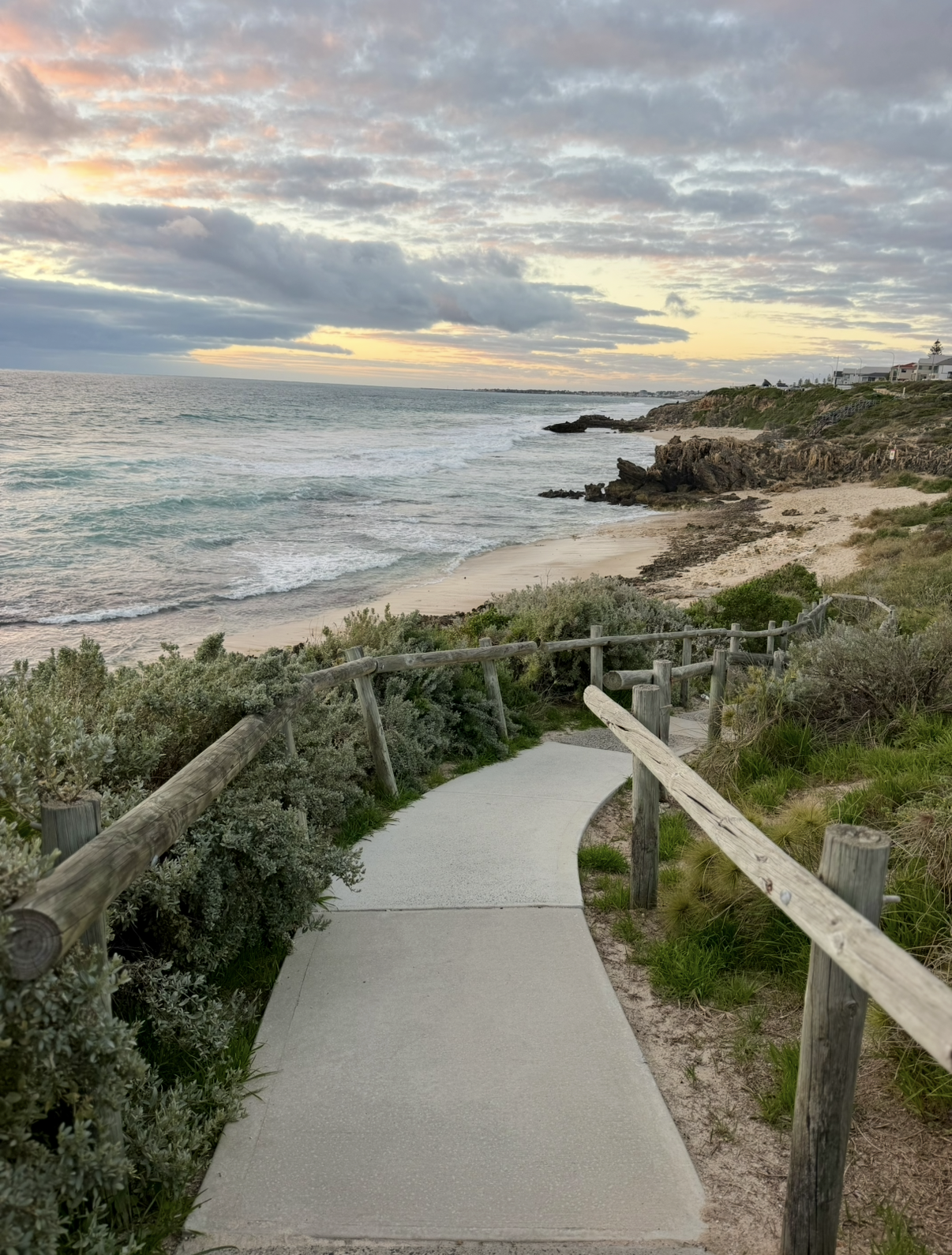
And when the sun decides it’s had enough and turns in for the night, it leaves us with the most magnificent sunsets.
Perth has some of the most beautiful sunsets I’ve ever seen, and I’ve seen some pretty amazing ones. Because Perth sits on the west coast of Australia, facing the Indian Ocean, the sun dips down into the ocean every evening and seems to paint the entire sky on its way down.
Pink, orange, gold, purple, sometimes all of them at once.
And it happens every single day.
Every.
Single.
Day.
It’s a phenomenon I’ve experienced before while traveling, but a completely surreal thing to see from the comfort of your own home, and on such a regular basis. It’s one of those “pinch-me” moments that we keep experiencing here in Perth and one I genuinely don’t think I’ll ever be numb to.
Of course, all that natural light comes with another discovery.
Apparently, I have been relying on flattering indoor lighting for approximately 40 years.
I had no idea how much the dimmer, warmer lighting in American homes was doing for me until I moved somewhere with this much natural light. Australia said, “Good morning, here is every single pore and silver hair you’ve ever earned.”
There is no hiding from it in Oz.
Food is… complicated
Food has been another interesting part of discovering our new normal. My three guys are all foodies, so they’ve been absolutely loving the food situation here. For me, it’s been a little more challenging. Australia is incredibly gluten-friendly, but being both gluten-free and vegetarian does make eating out a little more of an adventure. My options tend to revolve around salad, gluten-free pizza, or chips (fries), three things that I love, but that I’ve already grown pretty tired of. So we’ve found ourselves cooking at home much more and being more intentional about what we buy.
I also need to take a moment to address the Mexican problem in Australia.
Friends, I did not fully appreciate how much Mexican food was a part of my life until I moved to the other side of the planet.
There is very little good Mexican food here, which, to be fair, makes perfect geographical sense. We are about as far from Mexico as humans can reasonably get. But it is absolutely the food I miss the most.
And Fritos.
And ranch dressing.
I did not know Fritos and ranch were holding such an important place in my heart until they were suddenly unavailable.
Apparently, there are some things you don’t realize are part of your identity until you can’t buy them anymore.
Learning to drive like an aussie
Driving on the left is becoming second nature a little more every day. I still turn on my windshield wipers approximately half of the time I mean to use my turn signal, but we’re getting there. I’ve come a long way from that first jet-lagged drive from the airport in which I had no gps and no idea what I was doing.
I haven’t had many opportunities to drive because the car I bought is still somewhere in transit. I’m not entirely sure where it is, but much like everything I’ve ordered on Amazon since we’ve arrived, I assume it is traveling approximately 9,000 miles to get here and one magical day they’ll call me up and tell me it’s finally here.
And speaking of things you encounter on the road, kangaroos really are like the deer of Australia.
Just this weekend, I saw two on the side of the road that had been hit, and it was strangely familiar. It reminded me of seeing roadkill deer back home, except this time the animal on the side of the road was a kangaroo.
I’m told that it’s customary to check the pouch if you see a kangaroo that has been hit because there could be a baby joey inside.
So far, no joeys.
I’m sure there are plenty of Australians who are completely unfazed by seeing kangaroos along the road, but for me, there is still something surreal about driving along and realizing that the animal everyone else considers part of everyday life is a KANGAROO.
things that are almost familiar
We have Target and Kmart here, but they are definitely their own versions of Target and Kmart. The brands are different, the products are different, and there’s often just one option instead of an entire wall of choices.
And an unexpected discovery that tickles my retro-loving heart, layaway is still alive and well in Australia. Except here it’s called Layby.
I haven’t tried it yet, but I really want to.
Another phrase we hear constantly is “Easy,” “Too easy,” or “Easy as.” Everyone says it.
I understand the general sentiment. I’m still working on understanding exactly when I’m supposed to use each version. I’m hoping immersion will eventually sort that out.
Now that I think of it, this really isn’t that familiar at all.
Apparently, Australia has decided to spoil me
Just when I had decided everything was more expensive in Australia, I got my lashes filled today for the equivalent of about $28 USD, which is SIGNIFICANTLY cheaper than what I pay in the US. So, apparently there is a least one thing Australia has decided to subsidize for me personally. Thanks, Oz :)
During my appointment, my lash tech and I got to talking about some of the differences between the US and Australia, including healthcare, parental leave, and the wildlife situation.
She has lived in Perth for almost 11 years now and, according to her, in all that time she has never encountered a snake or a spider.
Three weeks in is far too early for me to call that a victory, but I am very interested in this data point.
Eleven years without a snake or spider sighting feels like pretty compelling evidence that perhaps the Australian wildlife situation is a little less dramatic than the internet would have me believe.
I’m choosing to believe it.
She did, however, make one thing very clear: sharks are a very real part of life here.
So apparently I can spend a little less time worrying about what might be hiding in the house and a little more time paying attention to what’s happening in the ocean.
Noted.
Of course, this could all be a bunch of malarkey. Time will tell.
the bigger differences
We also talked about some of the differences between the U.S. and Australia, particularly when it comes to healthcare and parental leave. She explained how Australia provides government-supported paid parental leave alongside publicly funded healthcare through Medicare. New mothers can receive around $950 per week from the government (again, everything is weekly here), in addition to paid leave through their employers, with some families able to take up to 12 months. New dads can take several weeks of paid leave as well.
What an amazing opportunity to prioritize bonding, adjusting, and simply settling in as a family during those first precious weeks and months. That’s a tradition I would gladly adopt. Not enough to make me want to start over with a newborn, mind you, but I do think it’s pretty amazing that families here can have that kind of time together.
When my boys were born, I felt lucky not to be fired. Forget getting paid or having any sort of guilt-free time at home with them. The expectation was basically to have a baby and then figure out how to get back to work as quickly as humanly possible.
Australia’s healthcare system also means that many hospital services are free or very low-cost for citizens, taking a tremendous financial burden off families when someone becomes ill or needs hospital care.
Just to be clear, we are not citizens or permanent residents yet, so sadly, none of that applies to us. I will say, though, that our full-coverage health insurance here costs a fraction of what our employee-sponsored plans cost in the U.S. And we have a $0 deductible plan.
No complaints here.
Just different
The chat with my lash girl was one of those conversations that made me stop and think about how differently two countries can approach the basic building blocks of everyday life.
And I think that’s what I’m enjoying most about being here.
We’re still very much in the “everything is new” phase of living in Australia, but I’m starting to realize that the novelty isn’t really about constantly comparing everything to home.
It’s about noticing.
Noticing how people do things differently. Noticing why certain systems make sense in this particular place. Noticing the words people use, the food that’s available, the way people interact, the rhythm of everyday life.
Some things are more expensive. Some are less expensive. Some are exactly what I expected. Some are completely unexpected.
And some things are simply different.
Not better. Not worse.
Just different.
And that might be one of the most interesting parts of moving to another country.
It’s not just the kangaroos and beaches and beautiful scenery. It’s discovering that the little, mundane parts of daily life can look completely different somewhere else.
We’re slowly figuring out what feels normal here, what we’ll eventually stop noticing, and what we hope we never stop noticing.
The sunsets are definitely going on that last list.
I have a feeling I’ll never get tired of watching the sun disappear into the ocean.
And yes, I am still mourning the Fritos and ranch.